
-
AI SEO
- Feb 13, 2026 How to Rank Better, Straight From a Google Search Advocate Feb 13, 2026
-
Company Updates
- Jul 5, 2018 Google Adwords Announces Rebranding Jul 5, 2018
- Jun 21, 2018 Squarespace Is Launching An Email Marketing Platform Jun 21, 2018
- Apr 12, 2018 Facebook Changes Their Algorithm Apr 12, 2018
-
Content Creation
- Jun 21, 2018 Squarespace Is Launching An Email Marketing Platform Jun 21, 2018
- Mar 1, 2018 Viral vs. Valuable Marketing Mar 1, 2018
- Feb 1, 2018 SEO: 3 Marketing Stats to Keep In Mind When It Comes to Search Feb 1, 2018
- Jan 4, 2018 4 Reasons Why Blogging Can Help Your SEO Jan 4, 2018
-
Email Marketing
- Jul 1, 2019 Average Email Open Rates By Industry Jul 1, 2019
- Sep 27, 2018 Squarespace Email Marketing Review Sep 27, 2018
- Jun 21, 2018 Squarespace Is Launching An Email Marketing Platform Jun 21, 2018
-
Facts & Figures
- Jul 19, 2018 How Marketing and Customer Relationship Management (CRM) are Connected Jul 19, 2018
- Jun 7, 2018 Search Engine Market Share Jun 7, 2018
- Mar 15, 2018 Some Quick Stats About Mobile and Marketing Mar 15, 2018
-
Google Ads
- Jul 5, 2018 Google Adwords Announces Rebranding Jul 5, 2018
-
Google Adwords
- Jul 5, 2018 Google Adwords Announces Rebranding Jul 5, 2018
-
Google Analytics
- May 24, 2018 Google Analytics: What Is Referrer Spam? May 24, 2018
- Apr 26, 2018 Reading Google Analytics: Direct Traffic Apr 26, 2018
-
Ineffective Marketing
- Aug 30, 2018 The Importance of Knowing Your Audience Aug 30, 2018
- Jul 19, 2018 How Marketing and Customer Relationship Management (CRM) are Connected Jul 19, 2018
- May 10, 2018 Advertising: Is It Based On Perspective? May 10, 2018
-
Marketing Strategy
- Feb 3, 2022 Marketing From Aristotle: Ethos, Pathos, and Logos Feb 3, 2022
- Mar 17, 2020 Why You Need To Keep Your Marketing During A Crisis Mar 17, 2020
- Jul 10, 2019 The Difference Between PR and Marketing (and where they overlap) Jul 10, 2019
- Jul 1, 2019 Average Email Open Rates By Industry Jul 1, 2019
- Nov 8, 2018 Don’t Leave Out The Psychographics When Building Your Marketing Plan Nov 8, 2018
- Oct 25, 2018 The 5Cs of Marketing Oct 25, 2018
- Oct 11, 2018 The Marketing Mix (Often Called The 4 Ps) Oct 11, 2018
- Sep 13, 2018 How To S.W.O.T. And Improve Your Marketing Plan Sep 13, 2018
- Aug 30, 2018 The Importance of Knowing Your Audience Aug 30, 2018
- Aug 2, 2018 What Place Does Marketing Hold In The Strategic Plan Of An Organization? Aug 2, 2018
- Jul 19, 2018 How Marketing and Customer Relationship Management (CRM) are Connected Jul 19, 2018
- Jul 5, 2018 Google Adwords Announces Rebranding Jul 5, 2018
- May 10, 2018 Advertising: Is It Based On Perspective? May 10, 2018
- Apr 26, 2018 Reading Google Analytics: Direct Traffic Apr 26, 2018
- Mar 15, 2018 Some Quick Stats About Mobile and Marketing Mar 15, 2018
- Mar 1, 2018 Viral vs. Valuable Marketing Mar 1, 2018
-
SEO
- Mar 1, 2021 We Quintupled Our SEO Keywords By Doing This Mar 1, 2021
- Jun 7, 2018 Search Engine Market Share Jun 7, 2018
- Mar 1, 2018 Viral vs. Valuable Marketing Mar 1, 2018
- Feb 15, 2018 SEO: What Is a “Nofollow” Link? Feb 15, 2018
- Feb 1, 2018 SEO: 3 Marketing Stats to Keep In Mind When It Comes to Search Feb 1, 2018
- Jan 4, 2018 4 Reasons Why Blogging Can Help Your SEO Jan 4, 2018
-
Small Business
- Feb 3, 2022 Marketing From Aristotle: Ethos, Pathos, and Logos Feb 3, 2022
- Mar 17, 2020 Why You Need To Keep Your Marketing During A Crisis Mar 17, 2020
- Jul 10, 2019 The Difference Between PR and Marketing (and where they overlap) Jul 10, 2019
- Nov 8, 2018 Don’t Leave Out The Psychographics When Building Your Marketing Plan Nov 8, 2018
- Oct 25, 2018 The 5Cs of Marketing Oct 25, 2018
- Oct 11, 2018 The Marketing Mix (Often Called The 4 Ps) Oct 11, 2018
- Aug 30, 2018 The Importance of Knowing Your Audience Aug 30, 2018
- Aug 16, 2018 Supply Chain Management In The Service Industry Aug 16, 2018
-
Social Media
- Aug 30, 2018 The Importance of Knowing Your Audience Aug 30, 2018
- Jul 19, 2018 How Marketing and Customer Relationship Management (CRM) are Connected Jul 19, 2018
- Apr 12, 2018 Facebook Changes Their Algorithm Apr 12, 2018
- Mar 1, 2018 Viral vs. Valuable Marketing Mar 1, 2018
-
Website Design
- Aug 16, 2018 Supply Chain Management In The Service Industry Aug 16, 2018
- Mar 29, 2018 What is Responsive Web Design? Mar 29, 2018

Search Engine Market Share
Most of us know that Google is the leading search engine, but just how far ahead is it compared to the competition? According to Net Marketshare, a website who proudly state they “provide web usage share statistics on real users (not bots),” Google’s market share is 72%:
Most of us know that Google is the leading search engine, but just how far ahead is it compared to the competition? According to Net Marketshare, a website who proudly state they “provide web usage share statistics on real users (not bots),” Google’s market share is 72%:
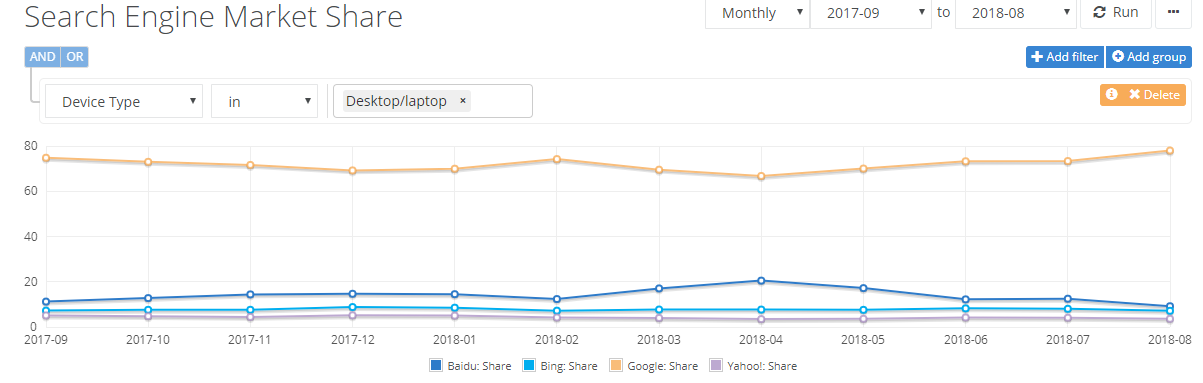
From September 2017 - August 2018, Google dominated with a 72% market share. Rounding out the top 10 were:
Google: 72.03%
Baidu (China): 14.11%
Bing: 7.76%
Yahoo!: 4.27%
Yandex (Russia): 0.95%
Ask: 0.35%
DuckDuckGo: 0.23%
Naver (South Korea): 0.11%
AOL: 0.05%
Dogpile: 0.04%
Why does this matter? You need to know where your customers are and where they are coming from, especially if you are considering running any Google Ads (or even Bing ads!). Want to know more about the importance of search engines and SERPs? Send us a message here.
References:
Search Engine Market Share. (2018). Net Marketshare. Source: https://www.netmarketshare.com/search-engine-market-share.aspx

SEO: 3 Marketing Stats to Keep In Mind When It Comes to Search
Search Engine Optimization (SEO) can be a daunting task. Data is always changing, as are people’s search patterns. Google, the number 1 search engine, processes over 3.5 billion searches per day, so what can your business do to stay competitive?
Search Engine Optimization (SEO) can be a daunting task. Data is always changing, as are people’s search patterns. Google, the number 1 search engine, processes over 3.5 billion searches per day, so what can your business do to stay competitive?
Obviously, the goal is always to be on the first page of the SERP (search engine results page). In fact, almost 92% of people do not even click on the second page, according to to Chitika statistics.
Despite the astronomical odds, there are still some positive things to consider. For one, search results are generally location based, so people searching for your services in your area usually won’t see results from another area first. In addition, not everyone uses search to find products or services - word of mouth and social media can go a long way! When creating content for your website, you should also remember that the blog you’re writing, the recommendation you posted or the product photos are pieces of information that can be shared elsewhere such as social media and email marketing.
Still, we want to create the best and most searchable website we can, right? With all that in mind, let’s look at 3 (of many!) statistics to take into consideration when updating your site.
Statistic #1: The average content length of a Google first page result is 1,890 words. (Backlinko)
What You Can Do: If you’re writing a blog, be thorough on the subject. Give examples, images, infographics, etc. BONUS: You can use the infographics for your social media pages. Research shows that infographics are “liked” and shared an average of 3 times more on social media than other any other type of content.
Statistic #2: HTTPS, rather than HTTP, generally ranks higher. Of the one million most visited websites, 51.2% of use HTTPS. (via WeLiveSecurity)
What You Can Do: Make your site secure! HTTPS stands for “HyperText Transfer Protocol Secure” and is the secure version of HTTP. This all has to do with how data is sent between a browser and a website. Basically, a 'secure' website means all of the exchanges of information between the browser and the site are encrypted. Google basically announced that all sites which are not HTTPS will not only rank poorer, but the user visiting the unsecured site will get a warning saying it isn’t safe. Read Google’s statement here. Wordpress, Squarespace, Weebly and more offer HTTPS sites, so you can look into one of those if your website needs a refresh.
Statistic #3: In the last year, 60% of people have started using voice search (via MindMeld)
What You Can Do: Try incorporating long tail keywords which can better match people’s natural way of talking. While a keyword is usually 1 word, a “long tail keyword” is a search phrase that contains 3 or more specific words.
Keyword example (head term): Superhero
Long tail keyword example: Superhero action figure, Superhero kid costumes, Superhero movies this summer
There are so many ways you can improve your online presence and search ranking. Be sure to stay in touch for future tips!
4 Reasons Why Blogging Can Help Your SEO
A large majority of bloggers publish content to help with their Search Engine Optimization, which can be a tricky thing. For starters, search engines like Google, Yahoo, Bing, Ask.com, AOL, DuckDuckGo and more are constantly changing their algorithms - and those algorithms are what match people's queries to your content.
A large majority of bloggers publish content to help with their Search Engine Optimization (SEO), which can be a tricky thing. For starters, search engines like Google, Yahoo, Bing, Ask.com, AOL, DuckDuckGo and more are constantly changing their algorithms - and those algorithms are what match people's queries to your content.
In addition, it seems like everyone is blogging and yours will just get lost in the mix. It can be overwhelming - in fact, some blogs tell you not to even try. Visit sites like Worldometers and you can see that over 4.5 millions blogs are published daily worldwide. Here's the catch, though, how many of those blogs are geared toward your target audience? How many of those articles have to do with what you are selling? Are they even in the same location as your business?
The answer: a fraction.
Blogging and creating content can serve different purposes. Here are 4 short reasons why:
1) It is a way to answer questions and concerns your past, current and prospective customers have. In addition to your FAQ page, try expanding on the question to answer in detail and address the sub-questions. Not only will this help a prospective customer, it will also help with SEO if you are using the right keywords.
2) It is unique and original content for you. Even if someone else has already written about the subject, this will be YOUR content associated with YOUR brand on YOUR website - a key to successful SEO.
3) It provides branded shareable content. Many companies share major news stories and information on their social media sites like Facebook, Linkedin and Twitter. However, sharing content - original content tailored to your business - that drives people to your website (instead of another news-site or blog) is absolutely more effective, especially if you close your blog post with a call-to-action (example: To learn more or to ask us any other questions about this subject, send us a message here).
4) You become a thought leader. A thought leader is the go-to person of the industry for people seeking advice. Having multiple, good articles about a particular industry means you become the expert on the matter and build your social currency. Research shows that people feel more comfortable buying from companies who show their experience and knowledge because it builds trust with the brand.
There are many, many more factors when it comes to successful SEO, but that's where Griffin & Co. Marketing comes in. If you have some questions, give us a shout. For now, though, think of starting that blog as your new year's resolution.