
-
AI SEO
- Feb 13, 2026 How to Rank Better, Straight From a Google Search Advocate Feb 13, 2026
-
Company Updates
- Jul 5, 2018 Google Adwords Announces Rebranding Jul 5, 2018
- Jun 21, 2018 Squarespace Is Launching An Email Marketing Platform Jun 21, 2018
- Apr 12, 2018 Facebook Changes Their Algorithm Apr 12, 2018
-
Content Creation
- Jun 21, 2018 Squarespace Is Launching An Email Marketing Platform Jun 21, 2018
- Mar 1, 2018 Viral vs. Valuable Marketing Mar 1, 2018
- Feb 1, 2018 SEO: 3 Marketing Stats to Keep In Mind When It Comes to Search Feb 1, 2018
- Jan 4, 2018 4 Reasons Why Blogging Can Help Your SEO Jan 4, 2018
-
Email Marketing
- Jul 1, 2019 Average Email Open Rates By Industry Jul 1, 2019
- Sep 27, 2018 Squarespace Email Marketing Review Sep 27, 2018
- Jun 21, 2018 Squarespace Is Launching An Email Marketing Platform Jun 21, 2018
-
Facts & Figures
- Jul 19, 2018 How Marketing and Customer Relationship Management (CRM) are Connected Jul 19, 2018
- Jun 7, 2018 Search Engine Market Share Jun 7, 2018
- Mar 15, 2018 Some Quick Stats About Mobile and Marketing Mar 15, 2018
-
Google Ads
- Jul 5, 2018 Google Adwords Announces Rebranding Jul 5, 2018
-
Google Adwords
- Jul 5, 2018 Google Adwords Announces Rebranding Jul 5, 2018
-
Google Analytics
- May 24, 2018 Google Analytics: What Is Referrer Spam? May 24, 2018
- Apr 26, 2018 Reading Google Analytics: Direct Traffic Apr 26, 2018
-
Ineffective Marketing
- Aug 30, 2018 The Importance of Knowing Your Audience Aug 30, 2018
- Jul 19, 2018 How Marketing and Customer Relationship Management (CRM) are Connected Jul 19, 2018
- May 10, 2018 Advertising: Is It Based On Perspective? May 10, 2018
-
Marketing Strategy
- Feb 3, 2022 Marketing From Aristotle: Ethos, Pathos, and Logos Feb 3, 2022
- Mar 17, 2020 Why You Need To Keep Your Marketing During A Crisis Mar 17, 2020
- Jul 10, 2019 The Difference Between PR and Marketing (and where they overlap) Jul 10, 2019
- Jul 1, 2019 Average Email Open Rates By Industry Jul 1, 2019
- Nov 8, 2018 Don’t Leave Out The Psychographics When Building Your Marketing Plan Nov 8, 2018
- Oct 25, 2018 The 5Cs of Marketing Oct 25, 2018
- Oct 11, 2018 The Marketing Mix (Often Called The 4 Ps) Oct 11, 2018
- Sep 13, 2018 How To S.W.O.T. And Improve Your Marketing Plan Sep 13, 2018
- Aug 30, 2018 The Importance of Knowing Your Audience Aug 30, 2018
- Aug 2, 2018 What Place Does Marketing Hold In The Strategic Plan Of An Organization? Aug 2, 2018
- Jul 19, 2018 How Marketing and Customer Relationship Management (CRM) are Connected Jul 19, 2018
- Jul 5, 2018 Google Adwords Announces Rebranding Jul 5, 2018
- May 10, 2018 Advertising: Is It Based On Perspective? May 10, 2018
- Apr 26, 2018 Reading Google Analytics: Direct Traffic Apr 26, 2018
- Mar 15, 2018 Some Quick Stats About Mobile and Marketing Mar 15, 2018
- Mar 1, 2018 Viral vs. Valuable Marketing Mar 1, 2018
-
SEO
- Mar 1, 2021 We Quintupled Our SEO Keywords By Doing This Mar 1, 2021
- Jun 7, 2018 Search Engine Market Share Jun 7, 2018
- Mar 1, 2018 Viral vs. Valuable Marketing Mar 1, 2018
- Feb 15, 2018 SEO: What Is a “Nofollow” Link? Feb 15, 2018
- Feb 1, 2018 SEO: 3 Marketing Stats to Keep In Mind When It Comes to Search Feb 1, 2018
- Jan 4, 2018 4 Reasons Why Blogging Can Help Your SEO Jan 4, 2018
-
Small Business
- Feb 3, 2022 Marketing From Aristotle: Ethos, Pathos, and Logos Feb 3, 2022
- Mar 17, 2020 Why You Need To Keep Your Marketing During A Crisis Mar 17, 2020
- Jul 10, 2019 The Difference Between PR and Marketing (and where they overlap) Jul 10, 2019
- Nov 8, 2018 Don’t Leave Out The Psychographics When Building Your Marketing Plan Nov 8, 2018
- Oct 25, 2018 The 5Cs of Marketing Oct 25, 2018
- Oct 11, 2018 The Marketing Mix (Often Called The 4 Ps) Oct 11, 2018
- Aug 30, 2018 The Importance of Knowing Your Audience Aug 30, 2018
- Aug 16, 2018 Supply Chain Management In The Service Industry Aug 16, 2018
-
Social Media
- Aug 30, 2018 The Importance of Knowing Your Audience Aug 30, 2018
- Jul 19, 2018 How Marketing and Customer Relationship Management (CRM) are Connected Jul 19, 2018
- Apr 12, 2018 Facebook Changes Their Algorithm Apr 12, 2018
- Mar 1, 2018 Viral vs. Valuable Marketing Mar 1, 2018
-
Website Design
- Aug 16, 2018 Supply Chain Management In The Service Industry Aug 16, 2018
- Mar 29, 2018 What is Responsive Web Design? Mar 29, 2018
Google Adwords Announces Rebranding
In the last week of June 2018, Google AdWords users across the globe received an email with important information: They are rebranding Google AdWords into Google Ads…
In the last week of June 2018, Google AdWords users across the globe received an email with important information:

That’s right! Google AdWords is going through a rebranding. According to their blog, Google states:
“We launched AdWords nearly 18 years ago with a simple goal—to make it easier for people to connect online with businesses...A lot has changed since then. Mobile is now a huge part of our everyday lives. People quickly switch from searching for products, to watching videos, browsing content, playing games and more. As a result, marketers have more opportunities to reach consumers across channels, screens and formats. The opportunity has never been more exciting, but it’s also never been more complex. Over the years, Google ads have evolved from helping marketers connect with people on Google Search, to helping them connect at every step of the consumer journey through text, video, display and more.
That’s why today we are introducing simpler brands and solutions for our advertising products: Google Ads, Google Marketing Platform, and Google Ad Manager. These new brands will help advertisers and publishers of all sizes choose the right solutions for their businesses, making it even easier for them to deliver valuable, trustworthy ads and the right experiences for consumers across devices and channels. As part of this change, we are releasing new solutions that help advertisers get started with Google Ads and drive greater collaboration across teams.”
The rest of the press release is available HERE.
For the most part, it seems that a majority of the Google Adwords (sorry, “Ads”) process will remain the same, with mostly aesthetic changes to the dashboard and logos:

Not to worry, we’ll keep you up to date with all the coming changes. At least Google was kind enough to save everyone a heart attack by assuring:
"There is no action required on your part, and changes to the Google Ads branding will not impact your campaign performance, navigation or reporting.”
-Griffin & Co. Marketing

Search Engine Market Share
Most of us know that Google is the leading search engine, but just how far ahead is it compared to the competition? According to Net Marketshare, a website who proudly state they “provide web usage share statistics on real users (not bots),” Google’s market share is 72%:
Most of us know that Google is the leading search engine, but just how far ahead is it compared to the competition? According to Net Marketshare, a website who proudly state they “provide web usage share statistics on real users (not bots),” Google’s market share is 72%:
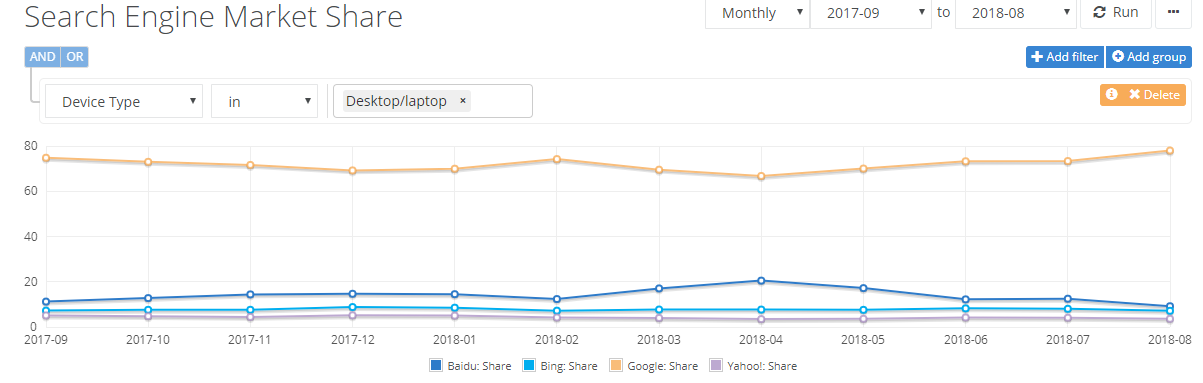
From September 2017 - August 2018, Google dominated with a 72% market share. Rounding out the top 10 were:
Google: 72.03%
Baidu (China): 14.11%
Bing: 7.76%
Yahoo!: 4.27%
Yandex (Russia): 0.95%
Ask: 0.35%
DuckDuckGo: 0.23%
Naver (South Korea): 0.11%
AOL: 0.05%
Dogpile: 0.04%
Why does this matter? You need to know where your customers are and where they are coming from, especially if you are considering running any Google Ads (or even Bing ads!). Want to know more about the importance of search engines and SERPs? Send us a message here.
References:
Search Engine Market Share. (2018). Net Marketshare. Source: https://www.netmarketshare.com/search-engine-market-share.aspx

Google Analytics: What Is Referrer Spam?
Google Analytics has the ability to show you how someone came to your sight (remember Direct, Organic, Paid and Referrals?). When it comes to referrals, however, there’s an annoying thing that can show up in reports: Referral spam.
Google Analytics has the ability to show you how someone came to your sight (remember Direct, Organic, Paid and Referrals?). When it comes to referrals, however, there’s an annoying thing that can show up in reports: Referral spam.
Here’s one of the best definitions I’ve found: “The technique involves making repeated web site requests using a fake referrer URL to the site the spammer wishes to advertise. Sites that publish their access logs, including referrer statistics, will then inadvertently link back to the spammer's site. These links will be indexed by search engines as they crawl the access logs, improving the spammer's search engine ranking. Except for polluting their statistics, the technique does not harm the affected sites. At least since 2014, a new variation of this form of spam occurs on Google Analytics. Spammers send fake visits to Google Analytics, often without ever accessing the affected site. The technique is used to have the spammers' URLs appear in the site statistics, inducing the site owner to visit the spam URLs. When the spammer never visited the affected site, the fake visits are also called Ghost Spam.”
As mentioned, the referrer spam doesn’t necessarily harm your website. It does, however, inflate your website visitor number which can be annoying when it comes to reporting. Although rare, it can also cause server overload if there are too many spam referrals.
How do you fix it? One of the best methods is by utilizing filters in Google Analytics to filter out the URLs that are bothering you. Start by going to Admin > All Filters > New Filter, and from there you can follow Google’s detailed instructions HERE.
References:
Referrer Spam.(2018). Wikipedia. Source: https://en.wikipedia.org/wiki/Referrer_spam

Reading Google Analytics: Direct Traffic
If you use Google Analytics (which, you definitely should be doing), you know that there are different “sources” of how people arrived to your website. The default types of traffic, or mediums, are: Direct, Organic, Paid and Referrals. Let’s talk about “Direct” traffic.

If you use Google Analytics (which, you definitely should be doing), you know that there are different “sources” of how people arrived to your website. The default types of traffic, or mediums, are: Direct, Organic, Paid and Referrals. Let’s talk about “Direct” traffic.
How about we start with Google’s definition?
“Source: Every referral to a website has an origin, or source. Possible sources include: ‘google’ (the name of a search engine), ‘facebook.com”’(the name of a referring site), ‘spring_newsletter’ (the name of one of your newsletters), and ‘direct’ (users that typed your URL directly into their browser, or who had bookmarked your site).”
Ok, but is there more beyond just direct URLs and bookmarks? Yes. Any kind of traffic that cannot be recognized is categorized as “Direct” by Google Analytics, which means:
Users using incognito/private browsing mode
As reported from other sources, there can be as much as an estimated 7% of organic traffic being shown as direct.
Many times, apps and other mobile traffic sources are often marked as “Direct.”
When a user follows a link on a secure (HTTPS) page to a non-secure (HTTP) page
I know, it’s frustrating. The good news is that you can help avoid many false “direct” traffic readings by adding parameters to URLs to identify the campaigns that refer traffic. HERE’S HOW.
References:
Traffic Source Dimensions. Google Analytics Help. (2018). Source: https://support.google.com/analytics/answer/1033173?hl=en
Google Makes It Even Harder to Estimate Missing iOS 6 Organic Search Data. Search Engine Watch. (2018). Source: https://searchenginewatch.com/sew/how-to/2274278/google-makes-it-even-harder-to-estimate-missing-ios-6-organic-search-data
Custom campaigns: Add parameters to URLs to identify the campaigns that refer traffic. Google Analytics Help. (2018). Source: https://support.google.com/analytics/answer/1033863?hl=en

Some Quick Stats About Mobile and Marketing
Mobile usage continues to grow. If you haven’t made a plan to utilize mobile advertising, it’s way past time. Do you use email marketing? According to Return Path, a company who focuses on email marketing data, mobile accounts for 55% of the open rate, which is up from 29% in 2012…
Mobile usage continues to grow. If you haven’t made a plan to utilize mobile advertising, it’s way past time. Do you use email marketing? According to Return Path, a company who focuses on email marketing data, mobile accounts for 55% of the open rate, which is up from 29% in 2012.
What about when it comes to search? Google reports that since 2015, more searches take place on mobile over desktops. In the current day and age, mobile searches account for OVER HALF of all searches. Google also reports that 51% of smartphone users have found a new company/product when searching with their mobile device.
What about social media? According to Statista, as of January 2018, over 95% percent of active Facebook user accounts use their smartphone to access the social networking site, compared to only 32% using their desktop.
For all of these reasons, and many, many more, it’s time to make mobile a priority in your business. Do you already have a responsive website? How mobile friendly is your company? If you’ve got questions, we’ve got answers.
References:
Mobile is Now the Preferred Platform for Reading Email with More than Half of All Email Opens. (2017). Return Path. Source: https://returnpath.com/newsroom/mobile-now-preferred-platform-reading-email-half-email-opens/
What We Searched for in 2015, and What That Means for Marketers. (2015). Google. Source: https://www.thinkwithgoogle.com/advertising-channels/search/what-we-searched-for-2015/
Being there in micro-moments, especially on mobile. (2015). Google. Source: https://www.thinkwithgoogle.com/marketing-resources/micro-moments/being-there-micromoments-especially-mobile/
Device usage of Facebook users worldwide as of January 2018. (2018). Statista. Source: https://www.statista.com/statistics/377808/distribution-of-facebook-users-by-device/

4 Reasons Why Blogging Can Help Your SEO
A large majority of bloggers publish content to help with their Search Engine Optimization, which can be a tricky thing. For starters, search engines like Google, Yahoo, Bing, Ask.com, AOL, DuckDuckGo and more are constantly changing their algorithms - and those algorithms are what match people's queries to your content.
A large majority of bloggers publish content to help with their Search Engine Optimization (SEO), which can be a tricky thing. For starters, search engines like Google, Yahoo, Bing, Ask.com, AOL, DuckDuckGo and more are constantly changing their algorithms - and those algorithms are what match people's queries to your content.
In addition, it seems like everyone is blogging and yours will just get lost in the mix. It can be overwhelming - in fact, some blogs tell you not to even try. Visit sites like Worldometers and you can see that over 4.5 millions blogs are published daily worldwide. Here's the catch, though, how many of those blogs are geared toward your target audience? How many of those articles have to do with what you are selling? Are they even in the same location as your business?
The answer: a fraction.
Blogging and creating content can serve different purposes. Here are 4 short reasons why:
1) It is a way to answer questions and concerns your past, current and prospective customers have. In addition to your FAQ page, try expanding on the question to answer in detail and address the sub-questions. Not only will this help a prospective customer, it will also help with SEO if you are using the right keywords.
2) It is unique and original content for you. Even if someone else has already written about the subject, this will be YOUR content associated with YOUR brand on YOUR website - a key to successful SEO.
3) It provides branded shareable content. Many companies share major news stories and information on their social media sites like Facebook, Linkedin and Twitter. However, sharing content - original content tailored to your business - that drives people to your website (instead of another news-site or blog) is absolutely more effective, especially if you close your blog post with a call-to-action (example: To learn more or to ask us any other questions about this subject, send us a message here).
4) You become a thought leader. A thought leader is the go-to person of the industry for people seeking advice. Having multiple, good articles about a particular industry means you become the expert on the matter and build your social currency. Research shows that people feel more comfortable buying from companies who show their experience and knowledge because it builds trust with the brand.
There are many, many more factors when it comes to successful SEO, but that's where Griffin & Co. Marketing comes in. If you have some questions, give us a shout. For now, though, think of starting that blog as your new year's resolution.